

How to Choose a Safe Kids Trampoline: Complete Buying Guide for Parents and Global Buyers
The backyard trampoline has become a staple of modern childhood. Whether it's for burning off energy on a Saturday afternoon or developing motor skills in a kindergarten playroom, the demand for high‑quality jumping equipment is at an all‑time high. However, as the market grows, the gap between "affordable" and "safe" continues to widen.
For a parent, the priority is simple: How do I keep my child from getting hurt?
For a global importer, retailer, or brand owner, the question is more complex: How do I source a product that meets international safety regulations, reduces liability, and maintains brand reputation?
This guide bridges the gap between those two perspectives. Drawing from years of experience as a Kids Trampoline Manufacturer, we will break down the engineering, material science, and manufacturing standards that define a truly Safe Kids Trampoline.
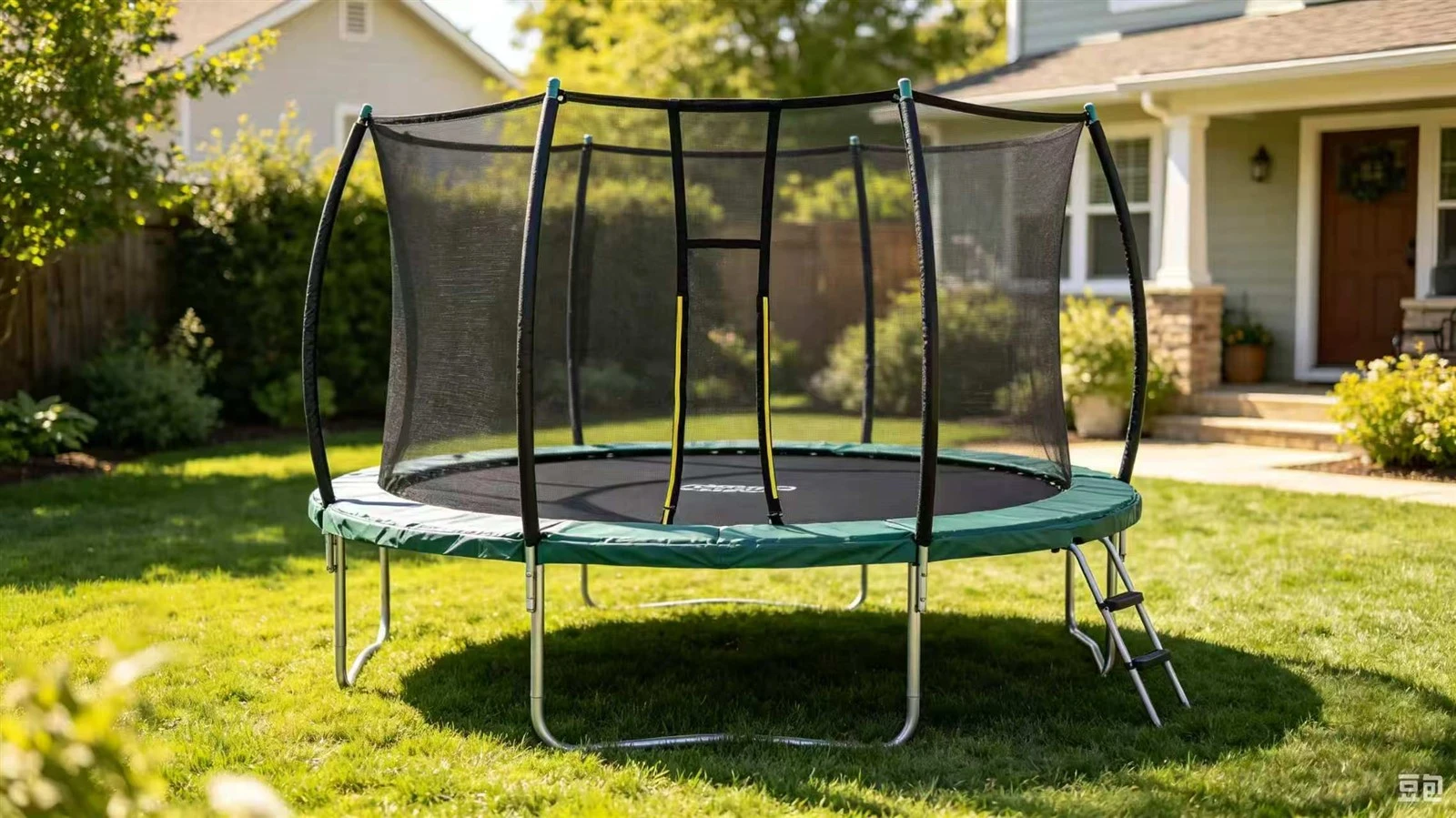
1. What Makes a Kids Trampoline Safe?
Safety is not an "add‑on" feature; it is an integrated result of structural engineering. When you look at two trampolines side‑by‑side, they may look identical. But beneath the surface, the difference in safety design can be life‑altering.
Stable Frame Structure: The Skeleton
The frame is the foundation. If the frame flexes too much or rusts from the inside out, the entire system becomes a hazard.
- Steel Gauge and Thickness: Cheap trampolines often use thin‑walled steel (1.0mm or less). A professional Kids Trampoline Factory will use a minimum of 1.2mm to 1.5mm galvanized steel for home use.
- Hot‑Dip Galvanization: This is a process where the steel is submerged in molten zinc. This ensures the tube is protected against rust both on the outside and, more importantly, on the inside where condensation builds up.
- Welding Quality: Look for smooth, robotic welds. "Cold welds" or hand‑welded joints with visible burrs can snap under the dynamic load of a jumping child.
Reliable Safety Enclosure: The Barrier
The safety net is the only thing standing between a child and a hard fall.
- Net Strength and Material: High‑density Polyethylene (PE) is the industry standard for its UV resistance. A safe net should be "finger‑safe," meaning the mesh holes are small enough that a child cannot get their fingers stuck or torn.
- Pole Design: Are the enclosure poles padded? More importantly, are they curved away from the net? "Arc" or "Bowl" designs prevent children from hitting the steel poles even if they fall into the net.
- Connection Design: The net should ideally be sewn or attached directly to the jumping mat (internal net design). This creates a "no‑gap" environment where the child cannot slip through to the springs.
Soft Protective Padding: The Cushion
The springs and frame are made of hard steel. The padding is the shield.
- Foam Density: Many retail trampolines use low‑density EPE foam that flattens in a month. We recommend high‑density, closed‑cell EPE foam that maintains its thickness.
- PVC vs. PE Covers: The outer cover of the padding should be high‑quality PVC. PE covers are cheaper but tend to crack and flake under sun exposure within six months. PVC is waterproof and UV‑resistant.
Proper Weight Capacity: The "Real" Limit
There is a massive difference between "Static Weight" (how much weight it can hold while standing) and "Dynamic Weight" (how much force it can handle during a jump). A Safe Kids Trampoline should have a dynamic weight limit that accounts for the G‑force of a jump, not just the body weight of the user.
2. Choosing the Right Size of Kids Trampoline
Size isn't just about how much space you have in the yard; it's about the "sweet spot" of the bounce.
| Size | Recommended Use | Best Environment |
| 36‑48 inch | Indoor toddler trampoline | Playrooms, small apartments |
| 6‑8 ft | Small kids/Single user | Small backyards, townhouses |
| 10‑12 ft | Family backyard trampoline | Standard gardens (The "Goldilocks" size) |
| 14+ ft | Large outdoor use | Large families, commercial recreation areas |
Small Kids Trampolines (Indoor/Toddler)
These are designed for low‑impact energy burning. They often use elastic bungees instead of steel springs to provide a softer, quieter bounce that won't strain a toddler's developing joints.
Medium to Large Outdoor Trampolines
As children grow, they need more space to prevent "collision" injuries. If you have two children, a 12ft or 14ft model provides enough surface area to reduce the chance of them bumping into each other-though our professional advice is always one jumper at a time.
3. Indoor vs. Outdoor Kids Trampoline: Which Is Safer?
This is a common debate for both parents and B2B buyers looking to fill their inventory.
Indoor Advantages
- Weather Independent: No UV degradation or rust.
- Easier Supervision: Usually placed in a living room or playroom where parents are present.
- Soft Surface: Often used with padded handle bars to help younger children maintain balance.
Outdoor Advantages
- Exercise Experience: Fresh air and more space allow for higher cardiovascular activity.
- Higher Capacity: Built with heavier steel to handle older children and higher jumps.
The Safety Verdict: Neither is inherently "safer" than the other. Safety depends on the Product Design and Supervision. However, outdoor trampolines require much more maintenance. If you are an importer, you must ensure your Outdoor Kids Trampoline uses high‑grade UV inhibitors in the plastic parts, or the safety net will crumble within a year.
4. Important Materials Used in Safe Kids Trampolines
From a manufacturing perspective, the bill of materials (BOM) is what determines the lifespan of the product.
The Jump Mat (PP Material)
The mat is the most stressed part of the trampoline. We use heavy‑duty Polypropylene (PP) with "carbon loading" for UV protection. A safe mat must have multiple rows of heavy‑duty stitching (usually 8 rows) on the V‑rings to prevent the springs from tearing away.
The Safety Net (PE or Terylene)
We recommend PE (Polyethylene) for outdoor use. It is naturally more resistant to the elements than nylon. For an OEM Kids Trampoline, we can customize the "GSM" (grams per square meter) of the net to meet the specific durability needs of the target market.
The Springs (High‑Tensile Steel)
Safety isn't just about the spring itself, but the shape. "Tapered" or "Waisted" springs provide a smoother deceleration at the bottom of the bounce, which is easier on a child's knees and ankles compared to cheap, straight springs.
5. Spring vs. Springless Kids Trampoline
This is a hot topic in the Kids Trampoline Safety Guide world.
Traditional Spring Trampolines
- The Pro: They offer the classic "high bounce" that older kids love. They are mature in technology and easier to repair.
- The Safety Fix: As long as the padding is thick and the net is internal (keeping the springs outside the net), they are perfectly safe.
Springless Trampolines
- The Pro: They use composite rods or bungee cords. This eliminates the "pinch point" risk entirely.
- The Trade‑off: They generally have a much higher manufacturing cost. For an importer, this means a higher retail price point, which may limit the market to "premium" buyers.
6. Global Safety Certifications and Standards
If you are an importer or a brand, you cannot rely on "promises." You need documentation. When vetting a Kids Trampoline Manufacturer, ask for these specific tests:
- ASTM F381‑16 (USA): The standard for components, assembly, use, and labeling of trampolines.
- EN71‑14 (Europe): The safety of toys-Part 14: Trampolines for domestic use.
- CE & GS Mark: Crucial for the European market, particularly Germany, signifying that the product has been tested by an independent body.
At our Kids Trampoline Factory, we ensure that every OEM Kids Trampoline is designed with these standards as the baseline, not the ceiling.
7. Common Mistakes When Buying a Kids Trampoline
Mistake 1: Choosing Only Based on Price
The "cheap" trampoline usually saves money on the things you can't see: the thickness of the steel, the quality of the thread, and the UV‑protection chemicals in the mat. A $150 trampoline that lasts 12 months is far more expensive than a $400 one that lasts 5 years.
Mistake 2: Ignoring the "No‑Gap" Design
Many older or cheaper designs have a gap between the mat and the net. This is where 80% of injuries happen-feet getting stuck in the springs. Never buy a trampoline where the net does not attach directly to the jumping surface.
Mistake 3: Buying From Unqualified Suppliers
For retailers, sourcing from a trading company instead of a direct Kids Trampoline Manufacturer can lead to inconsistent quality. You need a factory with a transparent Quality Control (QC) process.
8. How Manufacturers Ensure Kids Trampoline Safety
Behind the scenes at a professional factory, safety is a rigorous process. Here is how we do it:
- Material Inspection: We test the tensile strength of every batch of steel and the UV resistance of the fabric.
- Structural Testing: We use hydraulic machines to simulate 100,000 jumps on a single mat to check for stitching failure.
- Salt Spray Testing: We put our steel frames in a salt chamber for 48‑72 hours to simulate years of coastal air exposure to ensure rust‑proofing holds up.
- Finished Product Inspection: Before a container is loaded, we perform a random "AQL" (Acceptable Quality Level) inspection, fully assembling the unit to ensure all holes align and all parts are present.
9. How to Choose a Reliable Kids Trampoline Manufacturer
If you are an importer, your manufacturer is your most important partner. Look for:
- Manufacturing Experience: Have they been in the industry for 10+ years? They will have seen-and solved-common safety failures.
- OEM & ODM Capability: Can they customize the padding thickness or net height to meet your brand's specific safety claims?
- Communication Ability: A safe product starts with clear engineering drawings. If the manufacturer doesn't understand your technical requirements, they cannot build a safe product.
10. OEM Kids Trampoline Solutions for Brands and Importers
For global brands, a "standard" product isn't enough to stand out. You need a partner who can provide OEM Kids Trampoline Solutions.
Whether you want to develop a Private Label Kids Trampoline with unique colorways or a patented "easy‑click" assembly system, we provide the engineering support to turn an idea into a certified safe product.
Our OEM Process:
- Idea/Design: Share your target market and safety requirements.
- Prototyping: We build a sample for physical testing.
- Certification: We assist in getting the sample tested at labs like SGS or TUV.
- Mass Production: High‑consistency manufacturing with internal QC.
- Delivery: Logistics support for global shipping.
11. FAQ: Questions to Ask Before Buying a Kids Trampoline
Q: What age is suitable for a kids trampoline?
A: Most ASTM and EN71 standards suggest that full‑sized outdoor trampolines are for ages 6 and up. For children aged 3‑6, a specialized "Junior" or indoor trampoline with handle bars and lower‑tension bungees is much safer.
Q: How long does a kids trampoline last?
A: A high‑quality trampoline with a galvanized frame should last 5‑10 years. However, the soft parts (net and padding) usually need replacing every 2‑3 years due to weather exposure.
Q: Are outdoor trampolines safe in the wind?
A: Only if they are anchored. We always recommend using "U‑shaped" ground anchors to prevent the trampoline from becoming a projectile during a storm.
Q: What is the MOQ for OEM production?
A: Typically, for a Kids Trampoline Factory, the Minimum Order Quantity ranges from 200 to 500 units per size, depending on the level of customization required.
12. Conclusion: Safety Is a Choice, Not an Accident
Choosing the Best Kids Trampoline requires looking past the colorful padding and the marketing buzzwords. It requires an understanding of steel thickness, fabric density, and engineering standards.
For parents, it means doing the research and prioritizing safety features like internal nets and high‑density padding over the lowest price tag.
For global buyers, this means seeking a Kids Trampoline Manufacturer like MZ Trampoline, which offers transparent quality control, extensive OEM experience, and a steadfast commitment to international safety standards such as ASTM and EN71
Looking for a reliable kids trampoline manufacturer?
MZ Trampoline provides world‑class OEM and ODM trampoline solutions for global brands, wholesalers, and distributors. We don't just build trampolines; we build safe, durable equipment that brings peace of mind to parents and profit to our partners.
Contact our team today to discuss your custom trampoline project.